SEO vs. GEO: How to Win Search Visibility in the Age of AI
The digital marketing landscape has reached a defining turning point. Understand how SEO and GEO work together to keep your business discoverable in AI-first search.
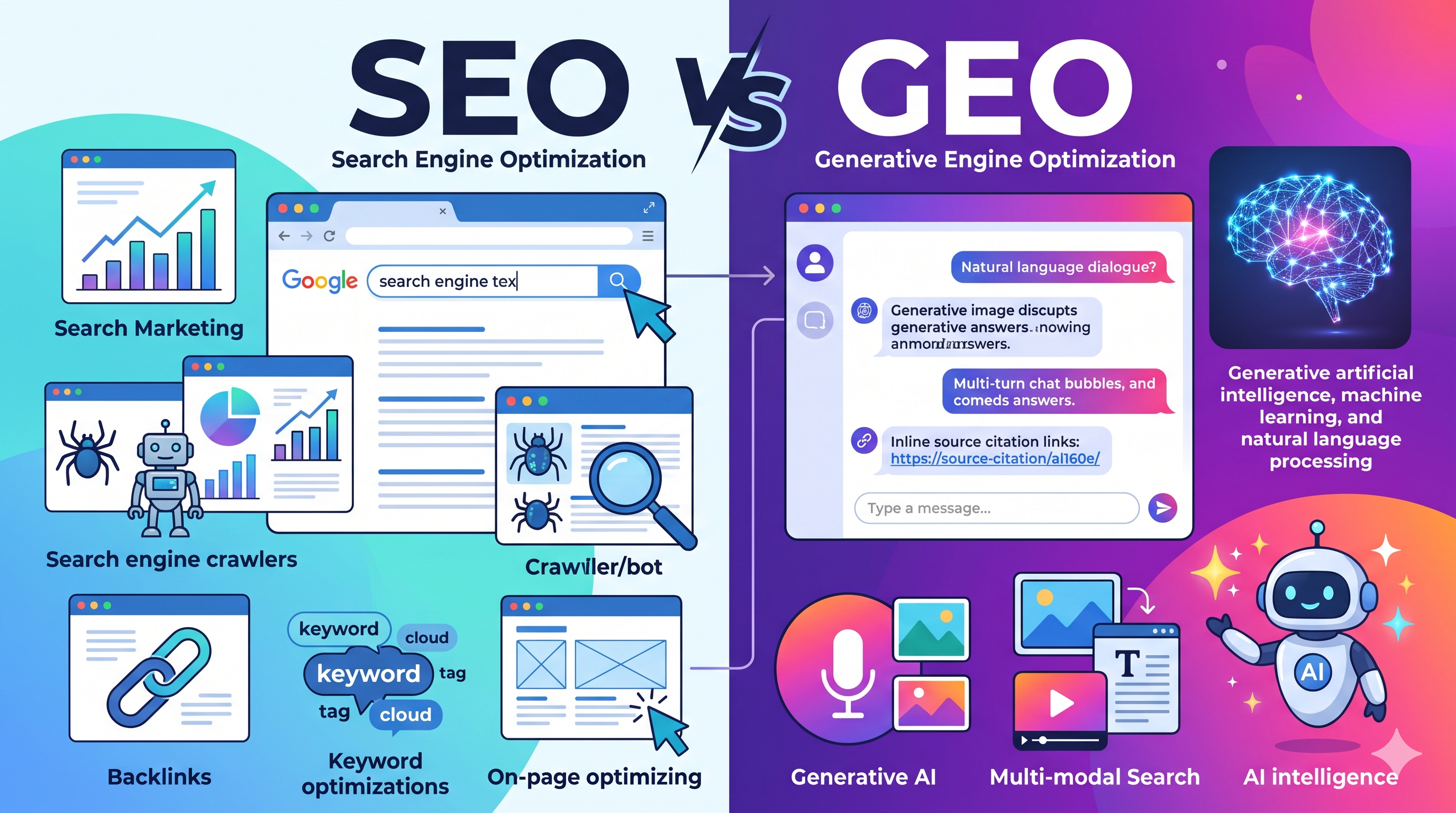
SEO vs. GEO: How to Win Search Visibility in the Age of AI
The digital marketing landscape has reached a defining turning point. For over two decades, search visibility was governed by a single, familiar playbook: Search Engine Optimization (SEO). You researched target keywords, optimized meta tags, built backlinks, and aimed for the top spot on Google's search results page.
Today, user behavior is fundamentally shifting. Instead of scrolling through ten blue links, searchers rely on AI tools—such as Google AI Overviews, ChatGPT, Perplexity, and Gemini—for direct, synthesized answers. This transformation has introduced a crucial new discipline: Generative Engine Optimization (GEO).
Understanding how SEO and GEO work together is key to keeping your business discoverable.
Defining the Difference: SEO vs. GEO
While both strategies aim to connect businesses with searchers, their core mechanics and goals differ:
| Aspect | SEO (Search Engine Optimization) | GEO (Generative Engine Optimization) |
|---|---|---|
| Primary Goal | Win page-one positions & drive organic clicks | Get cited, quoted, or recommended inside AI syntheses |
| Core Targets | Search crawlers (Googlebot, Bingbot) | Large Language Models (LLMs) & Retrieval Systems |
| Key Factors | Keywords, backlinks, page speed, technical health | Direct data points, entity authority, structured schema, E-E-A-T |
| Primary Metrics | Organic sessions, SERP rank, CTR | AI citation frequency, brand mention sentiment, referral traffic |
| Deliverable | Page #1 Link | AI Answer Citation |
Key Differences at a Glance
1. Primary Goal
- SEO: Win page-one positions & drive organic website clicks
- GEO: Get cited, quoted, or recommended inside AI syntheses
2. Core Targets
- SEO: Search crawlers (Googlebot, Bingbot)
- GEO: Large Language Models (LLMs) & Retrieval Systems
3. Key Optimization Factors
- SEO: Keywords, backlinks, page speed, technical health
- GEO: Direct data points, entity authority, structured schema, E-E-A-T
4. Primary Metrics
- SEO: Organic sessions, SERP rank, click-through rate (CTR)
- GEO: AI citation frequency, brand mention sentiment, referral traffic
How to Optimize for Both SEO and GEO
GEO is not a replacement for traditional SEO; it is a higher layer built on top of strong SEO foundations. AI models still heavily favor sourcing information from authoritative sites that search engines already index and trust.
To build a modern search strategy that wins both clicks and AI citations, focus on three core optimizations:
1. Lead with Clear, Direct Statements
AI models prefer concise explanations that answer a user's question directly in the first 1–2 sentences. Follow direct answers with bulleted breakdowns or tables to make data extraction effortless for AI tools.
2. Strengthen Experience & Expertise (E-E-A-T)
LLMs prioritize content verified by real expert data, quotes, and primary research over generic fluff. Include specific statistics, original insights, and clear author bios to build topic authority.
3. Implement Entity-Rich Schema Markup
Use Schema.org markup (Organization, Product, FAQ, Article). Structured data acts as an explicit translation layer, helping search crawlers and AI systems recognize who you are, what you do, and how your content connects to key topics.
The Path Ahead
Winning search visibility is no longer an either/or choice. Businesses that maintain clean technical SEO while structuring their content to earn AI citations will capture both traditional search traffic and the growing market of AI-first searchers.
Anuja Karande
Founder, ROIGrowthX — Specializing in SEO, GEO, and web development for growth-focused businesses.